

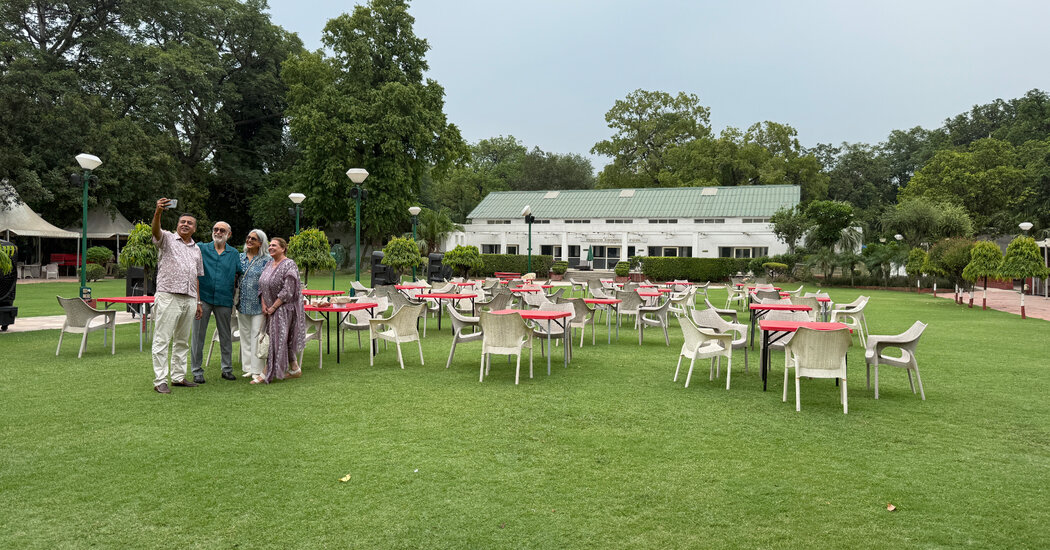
The air chillers struggled towards the thick air of an Indian summer time evening as members of Delhi’s fabled Gymkhana Membership sipped lime sodas and ate paneer on the garden, questioning if it is likely to be one of many final instances they might collect there.
A couple of hundred yards away, simply over a closely fortified wall, lives the rationale for his or her melancholy: Prime Minister Narendra Modi, whose authorities served the membership final week with an order to elucidate why it shouldn’t be evicted.
Based greater than 100 years in the past as a whites-only social membership for British colonial directors and their wives, the Gymkhana is now a refuge for Delhi’s homegrown elite. However with its imperial previous, the Gymkhana is dealing with extinction underneath Mr. Modi’s marketing campaign to purge India of what he calls a residual “slave mentality.”
The central authorities owns the land within the coronary heart of the Indian capital the place the Gymkhana sits — 27 lush acres with two swimming swimming pools, a library and tennis amenities which have been a cease on the professional circuit, with 26 grass and 7 clay courts. Authorities attorneys mentioned of their authorized submitting that the membership’s lease could be terminated as a result of the land is “critically required for strengthening and securing protection infrastructure,” amongst different causes serving the general public curiosity.
However members of the membership — largely present or retired civil servants, overseas service officers, army brass and others who make up the capital’s skilled class — say Mr. Modi’s authorities is manufacturing a land dispute to ship them a message: The times when Delhi’s outdated elite ran India are over.
“The phrase ‘elite’ is being bandied about,” mentioned Abhishek Tankha, 42, a businessman who frequents the membership for its squash courts and social scene. When he hears Mr. Modi and his followers use it to explain folks like him, Mr. Tankha mentioned he understands the cultural subtext: “It’s a selected sort of westernized Indian who by no means purchased Modi’s rhetoric, who Modi thinks by no means accepted him.”
A former member of the prime minister’s Bharatiya Janata Occasion, Mr. Tankha mentioned he believes the membership of the Gymkhana is being shamed and scorned. However, he requested, “Why shouldn’t we be pleased with our personal golf equipment?”
The stereotypical Gymkhana member, who typically needed to wait greater than 20 years earlier than being supplied a spot, is the sort of one who has misplaced essentially the most clout within the “New India” Mr. Modi says is rising underneath his watch — a rustic the place the secular, democratic ideas of its founders are giving method to his imaginative and prescient of a Hindu-first nation.
The escalating battles over establishments just like the Gymkhana are elevating advanced questions on id and heritage on this huge nation of 1.4 billion folks, the place a hybrid tradition has developed since Indians received independence in 1947. Indians have tailored many British imports to swimsuit their tastes, from their love of cricket to their tea tradition.
But the racial subjugation that was so elementary to British rule left scars that will not ever heal. Mr. Modi, who’s now serving his third time period as prime minister, has displayed a strong intuition for connecting previous injustices to the current, talking to the anxiousness among the many Indian lots for whom membership of a non-public membership is unthinkable.
Throughout Delhi, examples of Mr. Modi’s colonial erasure are all over the place — in gleaming new authorities buildings which have changed turn-of-the-century sandstone palaces, and on avenue indicators with Hindi and Sanskrit names the place Englishmen’s was.
Inside the previous few weeks, the Modi authorities has stepped up its efforts to grab two different colonial period landmarks in Delhi, together with the Jaipur Polo Floor, the place King Charles III, then Prince of Wales, as soon as performed.
“Within the journey of a developed India, it’s vital to maneuver ahead free from the colonial mind-set,” Mr. Modi mentioned in a speech celebrating the opening of a authorities advanced in Delhi that features a new workplace for himself, which he christened with a Sanskrit identify, Seva Teerth. The buildings being changed, nevertheless historic they might be, “had been constructed as symbols of the British Empire, supposed to maintain India chained in slavery for hundreds of years,” Mr. Modi mentioned.
Plans name for changing the 2 most iconic buildings — twin fortresses often called the Secretariat — right into a nationwide museum.
By taking up the Gymkhana, Mr. Modi is endeavoring to overcome one of the potent symbols of the British Raj. Golf equipment similar to it throughout British India — with white neoclassical clubhouses, massive verandas and expansive lawns — had been social hubs for the ruling elite. George Orwell centered a lot of the motion in his novel “Burmese Days” at one such membership, the Kyauktada, describing it as “the actual seat of the British energy.”
Solely within the waning days of the empire did the golf equipment start admitting Indians.
“Gymkhana Membership is just not merely a membership,” mentioned Rakesh Sinha, a former B.J.P. consultant within the higher home of Parliament who has championed Mr. Modi’s effort. “It was a feudal association,” he added, insisting that such establishments “haven’t any area within the capital, the place individuals are nonetheless struggling to search out fundamental housing.”
Shutting down the membership, Mr. Sinha mentioned, “is within the curiosity of the widespread folks.”
However critics of Mr. Modi’s strategy to reckoning with India’s previous say he’s slapping a “colonial” label on establishments which have been completely Indian for many years.
“Each civilization advances like this,” mentioned Swapna Liddle, a historian and conservationist in Delhi. “You are taking what’s there in your previous, you reshape it, redesign it, repurpose it and proceed to make use of it.”
India, Ms. Liddle added, has decolonized many establishments over time, together with the Gymkhana. “It began out as a racist, racially segregated membership,” she mentioned. “It was very a lot a British colonial product. It was then tailored to Indian situations.”
Efforts to de-Anglicize lengthy preceded Mr. Modi’s rise and have typically had broad assist. It was underneath the federal government of the rival political social gathering, Congress, that components of the Delhi cityscape had been renamed within the years after independence. Queensway, one of many predominant north-south thoroughfares, turned Janpath, or Folks’s Means in Hindi.
India has additionally renamed a few of its best-known cities, adjustments which weren’t universally well-liked. Bombay turned Mumbai in 1995; Calcutta turned Kolkata in 2001. Extra just lately, the legislature within the southern state of Kerala permitted altering its identify to Keralam to mirror the native tongue.
Indianization has taken many varieties, even altering what folks put on. At commencement ceremonies, mortar boards and robes that had been as soon as normal difficulty have been changed by loosefitting tunics known as kurtas.
Mr. Modi is the primary Indian prime minister born after independence, and Indianization was a precedence for him nicely earlier than he assumed energy in 2014. Below his watch, Indianization has broadened to focus on relics of India’s historic intervals of Muslim rule.
In February, Mr. Modi inaugurated maybe his most bold architectural testomony to decolonization but: a brand new workplace advanced to exchange the Secretariat buildings that housed a lot of the federal government work power — and earlier than 1947, the colonial administration.
He framed the moment in civilizational phrases, as he typically does when speaking about India’s relationship with the West. Folks would look again and say this was “when India redefined its future,” he declared.
On the Gymkhana, members thought they could have gotten a reprieve. Mr. Modi’s administration had tussled with the club prior to now over allegations of economic mismanagement, however little occurred.
Then got here an order in Could to vacate by June 5, adopted by the discover final week for the membership to look earlier than the federal government land workplace to plead its case. A listening to has been scheduled for the tip of the month.
Urmila Gupta, 82, turned a member in 1984 when the membership first gave voting privileges to girls. She sounded forlorn on the considered dropping a spot that turned her second residence in retirement. “Folks used to say the membership has the most effective grass courts east of the Suez,” she mentioned. “It has a legacy. And it has the correct to exist.”
Amman Singh, 29, a furnishings designer, grew up taking part in tennis on the membership on a membership handed down from his late grandfather, a former military common.
Mr. Singh mentioned the prime minister’s grievance with the membership made little sense. “Why is that this land, the land the Gymkhana membership is on, so essential to him?”
Like many youthful individuals who use the membership, Mr. Singh is just not technically a member. He mentioned when he utilized a number of years in the past, the wait was an estimated 28 years. There’s little query, he acknowledged, that the membership stays off limits for most individuals who dwell in Delhi.
“The membership is, after all, unique,” he mentioned, earlier than shortly clarifying. “It’s not elite.”
