

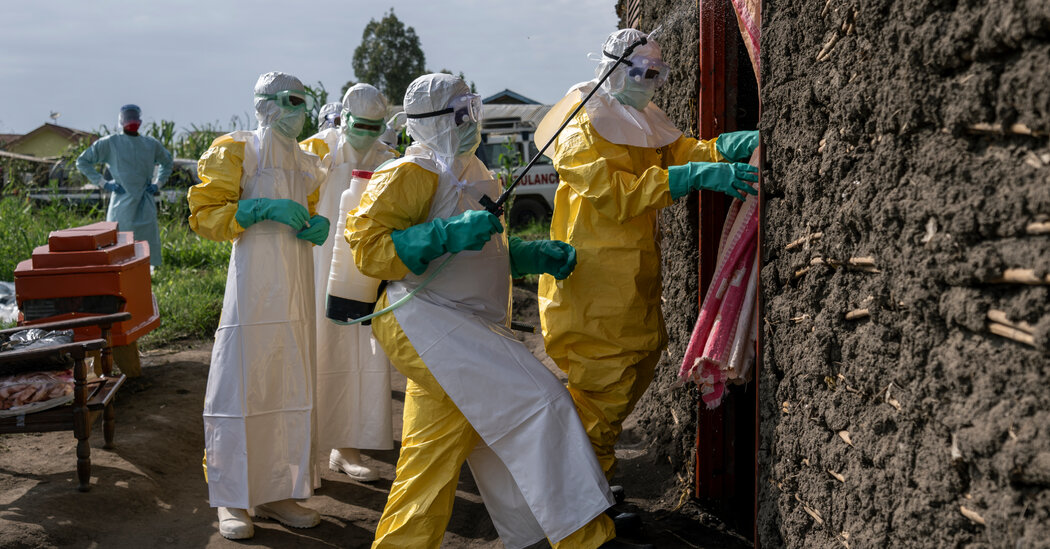
The Centers for Disease Control and Prevention said on Friday that a U.S. citizen had tested positive for Ebola in the Democratic Republic of Congo, where aid groups are struggling to contain an outbreak that has already killed over 600 people.
The American contracted Ebola from the Bundibugyo virus, the C.D.C. said. Little is known about the Bundibugyo pathogen, one of several viral species known to cause Ebola, and there are no targeted vaccines or treatment for it.
Three international health officials with knowledge of the case said the person was employed by Samaritan’s Purse, an American evangelical disaster relief organization. The officials, who are American and African, spoke on the condition of anonymity to discuss a sensitive issue.
Officials at Samaritan’s Purse and the U.S. Embassy in Congo’s capital, Kinshasa, did not respond to requests for comment.
Officials said the United States was working with the World Health Organization and Congolese officials on a plan to evacuate the American from Bunia, the capital of Ituri Province, where the outbreak has been concentrated. The options being considered include sending the person to a treatment center in Europe or the United States, one of the officials said.
The Trump administration has sought to establish a treatment center in Kenya for American Ebola patients, but the project has been blocked by the Kenyan courts. In addition to the legal obstacle, the center is not ready to accept patients, the official said.
The president of Samaritan’s Purse, the evangelist Franklin Graham, is a vocal supporter of President Trump who led prayers at his inauguration in January 2025. This year, Mr. Graham defended Mr. Trump over a social media post that depicted Mr. Trump as a Christlike figure.
Since the Ebola outbreak was declared a public health emergency on May 17, Samaritan’s Purse has established treatment centers in Bunia and the nearby town of Nyankunde, a former base for Christian missionaries. The affected Samaritan’s Purse employee was not working inside either of those treatment centers, one official said. That raises the prospect that the person was infected in the broader community.
The C.D.C. said it was working with the person’s employer, U.S. agencies, the public health authorities and Congolese partners to prevent further transmission and identify close contacts.
The last U.S. citizen who tested positive for the virus during the current outbreak was Dr. Peter Stafford, a medical missionary who contracted it in May while treating patients at a former mission hospital in Nyankunde. He was transported to the Charité University Hospital in Berlin, where he received experimental treatments. He has since recovered and returned to his home in the United States, according to Serge, his employer.
The Congolese health authorities said this week that 648 people had died from Ebola out of more than 1,800 cases. The virus has also spread to Uganda, which has reported 20 confirmed cases, including two deaths, the World Health Organization said. At least three separate international efforts are underway to rapidly develop a vaccine for Bundibugyo.
Health experts said that aid cuts by the Trump administration had shuttered crucial disease surveillance systems and medical supply chains that could have detected and contained the outbreak sooner.
Secretary of State Marco Rubio said in May that no Ebola patients would be allowed to enter the United States after the W.H.O. announced the outbreak in Congo. He later appeared to soften that stance.
U.S. officials later told reporters that instead of bringing home Americans exposed to Ebola, the Trump administration planned to send them to a quarantine facility in Kenya. That prompted a fierce outcry in a town near the planned center, with hundreds of people protesting it. A Kenyan court also ordered the suspension of those plans.
Trump administration officials have not articulated a clear plan since then for caring for Americans abroad who have been exposed to the virus.
